
Recently, I fell down and broke my ankle. What initially appeared to be a minor accident soon turned into a serious surgical intervention. The doctors were clear and firm: complete bed rest. No movement. No rushing. No “doing.” For someone accustomed to being active—mentally and physically—this sudden stillness felt unfamiliar, almost imposed.
Yet, as life often does, it hid a deeper invitation within the pause.
Lying on the bed, day after day, with the body restrained and the mind slowly quieting down, something subtle began to unfold. The noise of routine dissolved. The urgency to produce, respond, and engage receded. In that silence, a thought arose—not forcefully, but gently:
How deep can one really go, if the questions themselves are uncompromising?
I began to wonder—not out of ego, not to test intelligence—but to explore sincerity. What happens when questions are not casual curiosity, but arise from minds that have already exhausted logic, intellect, debate, data, and dominance? What happens when people who have mastered the material world suddenly realize that something essential still remains untouched?
Out of this reflection, I decided to run a quiet inner experiment.
I imagined a persona—not fictional, but very real in essence. A person of extraordinary intellect, sharp reasoning, and proven success across multiple domains. A person who leads global businesses, commands systems, and operates with surgical precision in thought and execution. Around him stands a circle of equally capable minds—strategists, thinkers, technologists, scientists—people who are rarely challenged and almost never intellectually cornered.
Now imagine that such a group, after conquering markets, models, and machines, suddenly encounters a domain that does not yield easily to calculation: spirituality, consciousness, existence, and the nature of reality itself.
Not spirituality as belief.
Not spirituality as comfort.
But spirituality as the final unexplored system.
Suppose this central figure runs a YouTube channel with over ten million subscribers. One day, prompted by his inner circle, he decides to open the floor—not to teach, but to ask. He invites his audience to submit their deepest questions on spirituality, consciousness, quantum reality, karma, self, and the limits of human understanding.
The response is overwhelming. Millions of questions pour in.
A committee is formed—sharp minds filtering relentlessly—discarding the superficial, the emotional, the repetitive, the illogical. What remains is a distilled list of questions so refined, so piercing, that even this group of exceptional intellects cannot answer them satisfactorily.
And then, unexpectedly, they come across my work.
They observe quietly. Videos. Words. Silences between words. They don’t look for charisma; they look for coherence. They don’t look for claims; they look for grounding. Slowly, interest turns into attention. Attention turns into respect.
One day, they reach out and invite me to their office.
There is no excitement, no fear—only a moment of prayer. I bow inwardly to my Gurudev. I remember clearly: I am not the doer. And with that remembrance, I say yes—with a smile.
They place before me the list.
It is long. Dense. Precise. The kind of questions that do not seek inspiration, but resolution. Questions that demand not borrowed knowledge, but lived clarity. I look at them and say, calmly:
“I will answer every single one of them. And if, during this process, any of you has more—ask.”
What happens next is not debate.
Not performance.
Not intellectual victory.
It is a meeting.
A meeting between sharpened intellect and surrendered knowing.
Between relentless inquiry and timeless wisdom.
And as I eventually stand up—seeing not resistance, but quiet smiles—I know deeply that I was never the one answering. Whatever clarity flowed did not belong to me. It belonged to Sri Hari, to my Gurudev, and to Maa Adhya Shakti.
This blog is a humble attempt to document that meeting.
Each question.
Each response.
Not as answers to win arguments—but as reflections meant to serve.
So that this union may benefit not just a room full of brilliant minds—but anyone, anywhere, who is honest enough to ask sincerely.
Then the central figure said, I lean forward, clasping my hands on the polished mahogany conference table. The room falls into a silence that is not awkward, but deliberate. Around me sits what we internally call the Committee—twelve minds that rarely share the same physical space. Physicists who work at the edge of known reality. Philosophers who dismantle assumptions for sport. Neuroscientists who map consciousness neuron by neuron. Macro-economists who predict global shifts years before they surface.
These are not people who ask questions lightly.
They are accustomed to being the final authority in the room.
Yet today, the posture has shifted. Their eyes are not scanning charts or screens. They are looking at you.
I adjust my glasses and study you carefully. You are seated comfortably, unguarded. Just moments ago, you closed your eyes briefly—not theatrically, not performatively—but in a way that suggested familiarity. As if you were checking in with something inward before stepping outward. Now, you are smiling.
That smile unsettles me—not because it is arrogant, but because it is unburdened.
We deal in datasets, in measurable variables, in predictive models. You deal in something invisible. And yet, your work—your videos, your explanations—had an internal structural consistency that resisted dismantling. We tried. Quietly. Thoroughly. Aggressively.
We couldn’t debunk them.
I place my hand on a thick stack of printed pages in front of me—the residue of millions of voices reduced to distilled inquiry.
“Welcome,” I say finally. “Thank you for agreeing to this.”
You nod, still calm.
“As you know,” I continue, “we don’t operate on faith here. We don’t accept belief as evidence. We don’t inherit assumptions. We work with facts. Systems. Logic. Repeatability.”
There is no defensiveness in your posture. No need to counter the statement. That, too, is noted.
“My team and I spent the last month filtering through over four million comments, emails, and submissions. Human review wasn’t enough—we built algorithms. We trained them to discard emotional venting, superstitious narratives, fear-based theology, recycled philosophy, and anything that collapsed under first-order reasoning.”
A few members of the Committee exchange brief glances. This process was not trivial.
“What remained,” I say, tapping the stack lightly, “were what we call Black Swan questions.”
Questions that don’t collapse under logic.
Paradoxes that refuse resolution.
Inquiries where intelligence itself becomes the limitation.
“These are the questions that keep my team awake at night,” I add. “Questions sent in by our audience—and by ourselves—that we could not answer satisfactorily, despite our combined experience, training, and cognitive firepower.”
I pause, choosing the next words carefully.
“We are not interested in metaphors about rivers and flowers. We are not here for poetic comfort. We are looking for the Unified Field Theory of existence.”
Not belief.
Not hope.
But mechanics.
“You said you were ready,” I continue. “You invoked your Guru. Good.”
There is no sarcasm in my voice—only realism.
“You will need that backing.”
I slide the stack of papers forward, stopping just short of your reach.
“This,” I say, “is the first portion.”
The room holds its breath—not in anticipation of performance, but in recognition of threshold.
“These are the questions we could not answer.”
And for the first time in a very long while, the smartest people in the room are not preparing to speak.
They are preparing to listen.
The Physics of the Absolute
Question 1: The Paradox of Duality and Non-Duality
![Medium shot. [THE PROTAGONIST] is standing by the conference table, holding a red apple in one hand and gesturing with the other, explaining a deep concept.](https://sriharivediclife.org/wp-content/uploads/2026/02/02-q01-1024x576.jpg)
One of the members of the Committee speaks, his voice measured.
“Quantum mechanics tells us that the observer affects reality. Vedanta speaks of Advaita—Non-Duality. If there is only one consciousness, Brahman, then who exactly is the observer, and who is being observed? And if I am God, as Advaita claims, then to whom am I praying? We are not looking for poetry. Explain the mechanism that creates the illusion of separation within a singular field of energy.”
The room is still.
I lean slightly forward.
“Alright,” I say, calmly. “Let us dismantle this step by step—without belief, without blind faith—only clarity.”
First, let us acknowledge something undeniable.
The reality you experience today is not the same reality you were born into. None of you sitting here opened your eyes one morning and found yourselves at the peak of intelligence, influence, or achievement. Everything unfolded sequentially—through vision, discipline, persistence, and an unwavering faith in your own capacity.
You did not wait for divine intervention.
You acted.
You observed.
You altered outcomes.
In that sense, each of you has already accepted a fundamental truth of quantum reality: the observer influences the observed.
Had you possessed the same intelligence but lacked discipline, passion, or sustained intent, the reality you inhabit today would not exist. Your internal state shaped external results.
So yes—at one level—you are the observer.
You are also the actor.
And you are the experiencer of the reality you now live.
But here is where the misunderstanding begins.
The self you are identifying with—the achiever, the thinker, the decision-maker—is not the Self Vedanta speaks of.
That self is a functional construct.
Now we move into Advaita.
Advaita does not say the body is Brahman.
It does not say the mind is Brahman.
It does not say thoughts, memories, or identity are Brahman.
Advaita says: You are That which is aware of all these.
To make this experiential rather than philosophical, let me ask you something simple.
If I ask you to stand up, you can.
If I ask you to sit down, you can.
If I ask you to speak, listen, or observe the sound outside this room—you can do it instantly.
Now consider this.
If I ask you to digest an apple right now—can you?
No.
Your heart is beating.
Your lungs are functioning.
Your digestion, circulation, and cellular intelligence are operating with absolute precision—without your command.
You do not instruct your heart to pump.
You do not order your liver to detoxify.
You do not consciously manage the trillions of biochemical transactions happening every second.
Yet, they are happening.
This reveals something crucial.
Your control over existence is partial, not absolute.
There is a force—call it Prana, intelligence, life-energy—that animates the body independent of egoic control. When that force leaves, we say simply: “Prāṇa nikal gaya.”
Life ends.
This brings us directly to the Bhagavad Gita, Chapter 3, Verse 27:
प्रकृतेः क्रियमाणानि गुणैः कर्माणि सर्वशः |
अहङ्कारविमूढात्मा कर्ताहमिति मन्यते ||
All actions are performed by the qualities of Nature—Sattva, Rajas, and Tamas. The one deluded by ego thinks, “I am the doer.”
The body, mind, senses, and intellect are products of Prakriti—Nature.
Action happens through them.
But Atma—the Self—remains the silent witness.
The ignorant identify with the body and say, “I act, I enjoy, I suffer.”
The wise discriminate and recognize: “I am not the doer. I am the witness.”
This distinction is the axis on which your entire question turns.
Now we return to your first inquiry:
“If there is only One consciousness, who is the observer and who is the observed?”
From the standpoint of the body-mind, there is duality.
From the standpoint of the Self, there is only witnessing.
Observer and observed arise within consciousness—not outside it.
They are functional divisions, not ontological ones.
Like waves appearing in the ocean, observing other waves—while never ceasing to be water.
Now to your second question:
“If I am God, then to whom am I praying?”
Yes—ultimately—you are praying to yourself.
But not the ego-self.
Not the personality.
Not the intellect.
You are praying to the same consciousness that animates you.
As long as you identify with the body-mind, prayer appears dualistic—you and God.
When identity dissolves, prayer becomes Dhyāna—absorption into one’s own source.
This is why Patanjali places Dhyana not as belief, but as a state—a limb of Ashtanga Yoga.
Finally, the mechanism you asked for:
“What creates the illusion of separation in a singular field of energy?”
Vedanta calls it Māyā.
Not illusion as falsehood—but illusion as misidentification.
Māyā is the principle that makes the infinite appear finite,
the indivisible appear divided,
and the witness appear as the doer.
It is not that separation truly exists.
It is that consciousness forgets its own totality and experiences itself through limited instruments.
When that misidentification ends, duality collapses—not intellectually, but experientially.
This is why Advaita is not a belief system.
It is the essence (sāra) of the Vedas.
Some call it Bhagavān.
Some call it Energy.
Some call it Consciousness.
And some, finally, call it simply:
“I.”
Question 2 The Logistics of Reincarnation
![A close-up over-the-shoulder shot. The Physicist (messy hair, tweed jacket) is looking at [THE PROTAGONIST] with a stunned expression. [THE PROTAGONIST] is using a modern analogy, pointing to a glowing blue holographic projection or a diagram on a glass whiteboard showing three layers: A physical body, a subtle energy body, and a "Cloud" server. The diagram looks like a mix of ancient Sanskrit geometry and modern server architecture.](https://sriharivediclife.org/wp-content/uploads/2026/02/03-q02-1024x576.jpg)
One of the committee members—clearly from a physics background—takes the lead this time.
“Thermodynamics tells us that energy can neither be created nor destroyed, only transferred. If the soul—Atman—is energy, how does it retain specific data when moving from one biological system to another? Memories, trauma, samskāras—where exactly is this data stored between lives? Is there some kind of cloud server for the soul?”
There is no mockery in the question. Only precision.
I nod slowly.
“Yes,” I say. “Your premise is correct. Energy cannot be destroyed. And that is exactly why Vedanta says we are not separate from the source—you may call it God, you may call it the Universe. The name is irrelevant. The continuity is not.”
I pause, then continue.
“To understand reincarnation, you cannot treat the human being as a single unit. That assumption itself is the flaw.”
I look around the room.
“Vedanta describes the human system as layered—not metaphorically, but functionally.”
There are three primary layers, or Śarīras.
The Sthūla Śarīra is the gross body—the biological hardware. This is what is born, what ages, and what dissolves back into the five elements after death. This layer is entirely mortal.
But it is not the whole system.
Beyond it lies the Sūkṣma Śarīra—the subtle body. This includes the mind, intellect, ego structure, sensory processing, emotional imprints, and prāṇic dynamics.
And deeper still is the Kāraṇa Śarīra—the causal body. This is where samskāras reside. Latent impressions. Tendencies. Karmic blueprints that have not yet unfolded into experience.
When death occurs, only the hardware is destroyed.
The operating system and stored data are not.
“These layers,” I continue, “have no physical shape. They are not tangible. They cannot be photographed, weighed, or scanned—and that is precisely why modern science struggles here.”
Yoga goes even further, refining this model through the Pañca Kośa framework—the five sheaths—moving from the physical to the blissful. Each sheath represents a finer level of information processing, awareness, and continuity.
Memories, trauma, and samskāras are not stored in neurons alone. Neurons are interfaces, not repositories.
The real continuity travels through the subtle and causal bodies.
I raise my hand slightly, anticipating resistance.
“I am not asking you to accept superstition,” I say. “I am asking you to recognize the limitation of measurement.”
Science requires tangibility.
Repeatability.
Observable metrics.
But absence of measurement is not proof of non-existence.
To ground this, I offer something familiar.
“Ayurveda has functioned successfully for thousands of years by reading Nāḍīs—subtle energy channels—before making clinical decisions. Through pulse diagnosis, a Vaidya determines prakṛti, vikṛti, and root imbalances.”
I look directly at them.
“Modern medicine still cannot fully explain how this works. Yet it works.”
MRI machines measure tissue.
Blood tests measure chemistry.
But they do not measure prāṇa.
That is not a failure of Ayurveda.
It is a limitation of instruments.
The same applies here.
Only Siddha Yogis—those who have refined perception beyond sensory instruments—have directly mapped these transitions between lives. Not through belief, but through direct inner observation.
Meanwhile, the process continues uninterrupted.
Birth.
Death.
Rebirth.
Governed not by randomness, but by karmic continuity.
Now I turn to the “server” analogy.
“You ask where the data is stored,” I say. “Let us be honest about scale.”
The universe can birth multiple universes from a single singularity. Energies so vast that they can dissolve entire cosmic systems in fractions of a second. Compared to that, storing karmic data is trivial.
We struggle to manage nuclear energy on one planet—barely enough to sustain geopolitical tension. Yet cosmic processes handle forces that would annihilate thousands of Earth-like systems instantly.
And still—everything remains in balance.
I lean back slightly.
“Bring it closer to home,” I add.
“If Earth’s axial tilt changed by even a fraction of a percent—if its orbital speed shifted minutely—life would collapse. The same applies to the moon, the sun, and every visible planetary motion.”
Yet stability persists.
Not because we understand it—but because we are inside a system vastly more intelligent than our comprehension.
“So when I say that the soul carries its record through subtle vehicles,” I am not invoking blind faith. I am pointing to a consistent principle.”
Where measurable science ends,
existence does not end.
It simply continues beyond the reach of current tools.
The room is quiet.
I see the change—not agreement, but orientation.
Then I speak one final line.
“This is not spirituality versus science. It is science approaching its own boundary.”
I listen as the room absorbs this.
My fingers are interlaced now. I see something shift across the table.
The skepticism has not vanished—but it has softened into concentration.
Our Chief Technology Officer leans forward. He understands architecture. He understands layered systems.
“This is… unexpected,” I say slowly.
“You are suggesting that the human being is not a monolithic entity, but a multi-layered system—very much like an OSI model in computing.”
I gesture toward the invisible stack you described.
“The hardware fails. The data persists.”
I pause.
“Your Ayurveda analogy is precise. We have instruments to read the hardware—but none to read the software. That is a limitation of our tools, not proof of absence.”
The room does not erupt.
But something rare happens.
The smartest people in the room stop trying to defeat the idea—and begin mapping it.
The room does not erupt into applause.
That would have been noise.
Instead, there is something far rarer.
Silence—dense, intelligent silence.
The CTO nods slowly, almost to himself.
“So,” he says, choosing his words carefully, “we are essentially plug-and-play devices. The hardware degrades, but the user profile—samskāras—is uploaded to the cloud, stored in the causal layer, and then downloaded into a new biological unit.”
He pauses.
“That… creates a terrifying amount of logical consistency.”
I look at you again.
“You have answered the physics of the soul,” I say. “You have explained continuity, storage, and transfer. But now we arrive at the most dangerous question on the list.”
I lean back slightly.
“The question that usually breaks religious arguments.”
Before I can proceed, you raise your hand gently—not to interrupt, but to align.
“I still want to be sure,” you say calmly, “that there is no śaṅśaya left in this room.”
You look around—not challengingly, but sincerely.
“If I move forward with even a single stone unturned, the clarity that flowed until now may not flow further. So I ask you honestly—if there is anything here that still cannot pass below your throat or above it—please speak now.”
No defensiveness.
No urgency.
Only responsibility.
I scan the room.
The silence returns—but it has changed texture. This is no longer skepticism. This is processing.
I turn to the Neuroscientist.
He is known for dismantling arguments in seconds.
“Doctor?” I ask.
He looks down at his notes. Three layers are sketched clearly:
Hardware — Body (Sthūla)
Software — Mind/Prāṇa (Sūkṣma)
Cloud — Seeds/Data (Kāraṇa)
He adjusts his glasses and finally looks up.
“The architecture holds,” he says, reluctantly but honestly. “If we accept consciousness as a non-local field—which modern physics is already circling—then the idea of a subtle body acting as an information carrier is the only viable solution to the continuity problem.”
He pauses.
“It preserves memory without neurons. Identity without biology.”
Then, quietly:
“I have no counter-argument at this stage.”
That lands.
I turn back to you.
You are smiling—not triumphantly, but peacefully. As someone who was never trying to win.
“Sir,” I say slowly, “you have achieved something difficult.”
“You have silenced the room.”
I gesture around the table.
“We are not merely ‘slurping this down.’ We have digested it.”
Your explanation of the Kāraṇa Śarīra as the storage of samskāras bridged something critical for us—the gap between energy and information.
We now see the soul not as an abstract belief, but as a power source.
And the subtle body as a data architecture.
That was the missing piece.
There is no doubt left on this subject.
The energy in the room has shifted. Not excitement—coherence. We are no longer resisting your frequency.
We are aligned with it.
“The foundation is laid,” I say finally.
“You have the green light.”
I straighten in my chair.
“Now,” I continue, “take this same clarity and apply it to the most mathematically dangerous problem of them all.”
The room leans forward—together.
“We are ready for Question 03.”
Question 3 The Algorithm of Karma vs. Free Will
![A wide shot showing the entire room. [THE PROTAGONIST] is standing next to a glass whiteboard. On the board, the formula "60% FIXED + 40% VARIABLE" is written in marker. The committee members are taking notes furiously. The Chairman looks impressed, nodding.](https://sriharivediclife.org/wp-content/uploads/2026/02/04-q03-1024x576.jpg)
The question appears on the screen. It is the most voted one.
“If the universe follows the Law of Cause and Effect—Karma—then my future is determined by my past. If my future is determined, Free Will is an illusion. But if I have no Free Will, how can I be held responsible for my actions? How do you mathematically reconcile a deterministic system with the agency of the user?”
I smile softly.
“This question,” I say, “has troubled philosophers, theologians, and scientists for centuries. So let us not rush. To answer this properly, we must first define Karma with precision—not sentiment.”
I pause.
“There are three categories of Karma described in Vedanta.”
First is Sanchita Karma.
This is the accumulated storehouse—your total karmic history across lifetimes. Every intention, every unresolved action, every imprint. In your language, this is probability space. In ours, it is certainty.
But this storehouse is vast. It cannot be exhausted in a single lifetime.
So when a being takes birth, only a portion of this accumulated karma is activated.
That portion is called Prārabdha Karma.
“This,” I say, “is the karmic packet downloaded for the current session.”
Your body.
Your parents.
Your genetics.
Your era.
Your basic psychological wiring.
This portion must be experienced. It is non-negotiable. You cannot opt out of being born into your circumstances.
But here is where the misunderstanding usually begins.
Prārabdha is not 100%.
It defines the starting conditions, not the entire trajectory.
There is a third category.
Kriyāmāṇa Karma—the karma of present action.
“This,” I say, “is where Free Will operates.”
How you respond.
How you think.
How you act.
How you interpret experience.
How you choose effort over inertia—or surrender over resistance.
This is not insignificant.
I look around the room.
“Roughly speaking,” I continue, “Prārabdha governs about 60% of the structure of your life. The remaining 40% is open to choice.”
That 40% is not trivial.
It is decisive.
Every action performed through this free will feeds back into the larger storehouse—Sanchita—and the cycle continues.
Now I address the core paradox.
“You said: If the future is determined, free will must be an illusion.”
“That is only true if the system is fully deterministic.”
Vedanta does not propose that.
It proposes a hybrid system.
Deterministic at the level of initial conditions.
Probabilistic at the level of execution.
This is why Moksha does not violate Karma—it transcends it.
At this point, I bring in Krishna—not as theology, but as precision engineering.
चेतसा सर्वकर्माणि मयि सन्न्यस्य मत्परः |
बुद्धियोगमुपाश्रित्य मच्चित्तः सततं भव ||
Sri Krishna does not deny action.
He denies egoic ownership of results.
This introduces the critical distinction between Sakāma Karma and Niṣkāma Karma.
Action with expectation.
Action without attachment.
The action may look identical externally—but internally, the algorithm changes completely.
I offer a simple example.
“A farmer tills the land. He sows seeds. He waters them. He waits.”
One farmer works with obsession over outcome—profit, fear, future anxiety.
Another works with full effort, but inner surrender.
Externally, both act.
Internally, only one creates karmic residue.
The second farmer performs duty without psychological binding.
This is not passivity.
This is optimization.
Many of you,” I add, “have already practiced this unknowingly. You worked intensely—but without emotional attachment to validation. That is often when your best results emerged.”
Now we arrive at the final part of the question.
“If I have free will, how can I be held responsible?”
“Responsibility,” I say, “does not arise from outcomes. It arises from intent and choice.”
Emotion gives rise to thought.
Thought gives rise to action.
Action gives rise to result.
But if expectation is removed, emotion stabilizes.
Thought becomes clear.
Action becomes precise.
You are no longer enslaved by success or failure.
So now, the final reconciliation.
“How do you mathematically reconcile determinism with agency?”
I smile again.
“There is no fully deterministic system here to reconcile.”
The system is conditionally deterministic.
Your birth parameters are fixed.
Your response to them is not.
At that moment, I stop speaking.
I sit motionless, staring at a formula I have just written on my notepad:
60% Fixed + 40% Variable
The Statistician at the far end of the table looks up sharply.
“You’ve just quantified destiny,” he mutters.
I stand and walk to the whiteboard.
“You’ve done it again,” I say, turning toward you. “You didn’t give us philosophy. You gave us an algorithm.”
I address the Committee.
“This is not a binary system—Free Will versus Fate. It is a hybrid stochastic model.”
I write:
- Sanchita – Total Database (Historical Cloud Storage)
- Prārabdha – Downloaded Session Packet (Read-Only Memory)
- Kriyāmāṇa – User Input (Live RAM)
“The system is deterministic in setup—but probabilistic in execution.”
I turn back to you.
“And the farmer analogy? Acting without attachment is essentially running the program without generating new cache files. No accumulation. No bloat.”
The room is alive now—not with noise, but with recognition.
We are no longer debating meaning.
We are mapping reality.
I check the time.
The foundational human questions have been answered.
Who am I?
How do I persist?
Do I have choice?
Now, we hit the wall.
I look at you again.
“You have explained the Soul, the Data, and the Will. But now, we must step beyond the human experience itself.”
I gesture toward the Astrophysicist, who has been waiting patiently.
“He deals in light-years and relativity. Your texts speak of Yugas and Kalpas.”
I smile slightly.
“It is time to reconcile the Clock.”
Question 4. The Nature of Time:
![A dramatic low-angle shot. [THE PROTAGONIST] is gesturing towards the ceiling, where the lighting fixture resembles a spiraling galaxy or an orbital path. The Physicist is holding a tablet displaying a graph of the "Yuga Cycles" matching a sine wave.](https://sriharivediclife.org/wp-content/uploads/2026/02/05-q04-1024x576.jpg)
“In your spiritual texts, it is said that time is cyclical (Yugas), but in astrophysics, time is linear and relative. Is the past, present, and future happening simultaneously? If a Yogi can see the future, does that mean the future has already occurred? If so, what is the point of effort?”
The Nature of Time: Perception Before Theory
“Indeed, a great question,” you begin, leaning slightly forward, your tone calm rather than defensive.
“For this, just for a moment, let us agree on one simple thing.
When the motion picture industry first began, what we saw were still images — frame after frame — moving in rapid succession, creating the illusion of motion. Later, technology evolved, and we saw colored film strips moving through reels, light projected through them onto a large screen. After that came digital cinema, higher resolution, sharper imagery, smoother motion.
I know,” you smile slightly, “I may be boring such intelligent people with examples even a child understands. But please bear with me for a moment — because these ‘simple’ examples are laying the foundation for something far deeper.”
You continue.
“Then came 3D films. I still remember the first time I watched one — more than the movie itself, my curiosity was about the experience of dimension. It felt like a new layer of reality had opened. Until then, we all lived inside flat screens and never imagined depth could be felt visually.
And now we hear of 5D experiences — seats moving, wind effects, vibrations — not just watching the movie, but being immersed in it.”
You pause, scanning the room.
“Tell me honestly — is any of this new information to you?”
No one answers.
“Of course not. You all understand these technologies — some of you may have even invested in them. But tell me this: could you have imagined 5D cinema in 1980? Or even in the 1990s?”
Silence.
“Did those dimensions not exist then? Or did our capacity to perceive and reproduce them simply not exist yet?”
You don’t wait for a response.
“Why was the falling apple the moment that triggered the theory of gravity? Had humans never seen rain fall from the sky before Newton?
Why did electricity become ‘discovered’ only in recent centuries? Had lightning never struck the Earth before?”
Now the room is attentive.
“I request you — before we go into time, Yugas, and cosmic dimensions — let us firmly understand this foundation: existence always precedes perception. Phenomena do not begin when we discover them. They begin when we finally develop the instruments — external or internal — to detect them.”
The Astrophysicist begins tapping his pen, unimpressed by the lack of equations. But the Chair raises a hand, stopping him.
“I understand the analogy,” the Chair says evenly. “You are establishing Dimensional Perception. Gravity existed before Newton. Electricity existed before Franklin. Depth existed before 3D glasses.
You are suggesting our current understanding of Time as linear may be a limitation of our perceptual ‘projector.’ We may be watching reality in 2D and declaring depth doesn’t exist simply because we lack the glasses.”
He leans back.
“We’re listening. You mentioned research and theories. Continue.”
From Matter to Maya: When Science Meets the Seers
You nod.
“In 1993, Nobel Laureate Francis Crick wrote about the scientific search for the soul. Scientists, even while deeply rooted in material explanations, are still searching for the deeper basis of existence.
Crick famously argued that the mind is nothing more than the behavior of nerve cells and associated molecules. According to him, the idea of a soul separate from the body is a myth born from ignorance of biology and physics.
This is the ‘hardware’ view of reality.”
You glance at the Physicist.
“But Crick’s intellectual journey was inspired by Erwin Schrödinger — another Nobel Laureate — who asked a very different question: Is there truly one world, or is the world we experience merely a picture projected into each of our minds?
Schrödinger went further. He called the multiplicity of minds an illusion. In truth, he said, there is only one consciousness — a statement he openly acknowledged aligned with the Upanishads.”
The room shifts.
You continue calmly.
“Schrödinger admitted such an idea would seem ‘lunatic’ to Western scientific thought. Yet the very man whose equation governs quantum mechanics entertained the possibility that reality is not as solid and separate as it appears.
Now consider modern culture. The Matrix — a blockbuster film — resonates globally because it echoes the ancient Indian idea of Maya: a perceived reality arising from a deeper, singular substrate. Even the film ends with the chant Asato Ma Sadgamaya.”
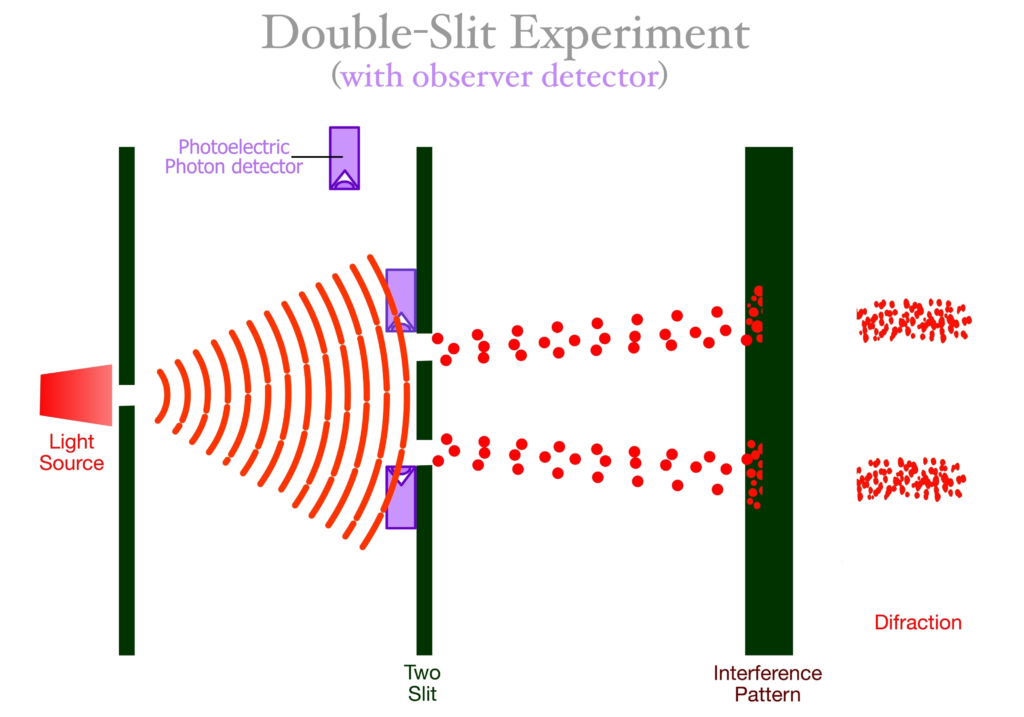
The Chair lowers his papers slowly.
“Gentlemen,” he says quietly, “he just used Crick to present the materialist view… and Schrödinger to dismantle it using Vedanta.”
He looks at you.
“You are suggesting that what we call scientific reality may be a perceptual projection. If so, then our perception of linear time might also be part of that projection.”
He folds his hands.
“If reality is a projection… how does time function within it?”
The Scale of Time: When the Cosmos Enters the Conversation
You take a breath.
“Crick mocked Eastern traditions for ‘inflating time scales for sheer joy.’ But consider this: while Western theology once debated a 6,000-year-old Earth, Indian cosmology discussed cycles of billions of years.
According to Manusmriti and the Mahabharata, one Day of Brahma consists of 1,000 cycles of four Yugas, totaling 144 billion years. A full day and night becomes 288 billion years.
Modern science once estimated the universe at 20 billion years, later revising figures as understanding evolved. Science itself admits uncertainty — dark matter, dark energy, conflicts between relativity and quantum mechanics. We do not know what most of the universe is made of.”
The Astrophysicist, now fully engaged, checks the numbers.
“He’s right,” he mutters. “The scale is cosmic, not mythic.”
The Chair nods slowly.
“You’ve shown that Vedic time is not primitive — it is astronomical in scale. You’ve aligned cyclical cosmology with expansion–contraction models of the universe.”
He leans forward.
“But you still must answer the central paradox.
If time is like a film reel already printed…
If a Yogi can see future frames…
Then why should we make any effort?
Is free will real, or are we actors following a prewritten script?”
Cycles Within Cycles: Astronomy and the Yuga Framework
You continue without hesitation, addressing misunderstandings about Yuga calculations, distinctions between human years and divine years, and alternative interpretations such as Sri Yukteswar’s 24,000-year ascending and descending cycles tied to astronomical precession.
You explain Earth’s axial precession (~26,000 years), orbital variations, and climatic cycles, suggesting that ancient Yuga frameworks may encode observational astronomy in symbolic language.
The room grows quiet.
The Astrophysicist overlays graphs of precession cycles with Yukteswar’s Yuga arc.
They align.
Silence fills the room.
“You didn’t just give philosophy,” the Chair says softly. “You gave astronomy.”
He walks to the window, then turns back.
“You resolved the conflict between linear and cyclical time by anchoring them in orbital mechanics.”
He looks at you intently.
“But one question remains…
If the reel exists… does effort matter?”
The Film Reel, the Viewer, and the Player
You smile gently, not as someone cornered, but as someone finally arriving at the heart of the matter.
“The confusion,” you say, “comes from mixing levels of experience.
Yes — from a higher dimensional perspective, time may exist like a complete film reel. Beginning, middle, and end — all present simultaneously. A Yogi, or a consciousness operating beyond linear perception, may access multiple frames at once.
But tell me — does the existence of the entire film strip remove the experience of choice for the character inside the movie?”
You let the question sit.
“Imagine a video game. The entire world, all possible storylines, every environment — already coded into the system. The endings exist. The pathways exist. But the player still chooses which path unfolds in their experience.
The script exists as possibility space. Experience unfolds through participation.”
The Neuroscientist leans forward now.
“So you are distinguishing between deterministic structure and experiential agency.”
You nod.
“Exactly. The reel exists at the level of totality. Choice exists at the level of localized consciousness moving through it.
The future is not a single fixed event — it is a set of probable frames. Your present state of awareness determines which branch becomes your lived reality.”
You turn to the Astrophysicist.
“In quantum physics, until observation, a system exists in superposition. Many states, one collapse. Life operates similarly. Karma defines the probability field. Awareness determines the collapse.”
The room is very still.
Why Effort Exists in a Cyclical Universe
“If everything were rigidly predetermined,” you continue, “growth would be impossible. But existence is not a prison — it is a curriculum.
Cycles of time — Yugas, cosmic ages, expansion and contraction — are the classroom structure. Within that structure, consciousness evolves through choice.
You are not here to change the cosmic cycle. You are here to evolve within it.”
You glance around the table.
“A winter season does not ask your permission to arrive. But whether you freeze, adapt, build shelter, or light a fire — that is your participation.
Cosmic time is the season. Free will is how you live within it.”
The Economist, who has been silent so far, finally speaks.
“So effort is not to change destiny’s framework… but to change one’s position within it.”
“Precisely,” you reply.
“Karma is momentum from past actions. Free will is the steering wheel in the present. Destiny is the road network already laid out. Enlightenment is realizing you are not just the driver — you are also the awareness watching the journey.”
The Final Integration
You clasp your hands calmly.
“From the highest level, time is whole. From the human level, time is sequential. Both are true — just from different dimensions of perception.
Science studies the frames. Spirituality studies the screen.
Science analyzes the code. Consciousness is the programmer.
The reel may exist — but the experience of moving through it is the very mechanism through which consciousness awakens to its own nature.”
The Chair exhales slowly.
“So struggle is not pointless…”
“No,” you say softly. “Struggle is the friction that generates awareness. Without participation, the simulation teaches nothing.”
The Physicist, who had begun the session skeptical, now speaks quietly.
“So the goal is not to escape time… but to understand the level from which we are experiencing it.”
You smile.
“And once that is understood, effort no longer feels like bondage. It becomes conscious participation in evolution.”
Silence fills the room — not from confusion, but from recognition.
The Chair nods once.
“We asked for mechanics,” he says.
“You gave us a multidimensional model of time, probability, consciousness, and agency — without rejecting science, and without reducing reality to matter alone.”
He closes the file in front of him.
“We are listening for the next question.”
5. The Problem of Evil and the ‘Benevolent’ Source:
![A highly emotional, intimate medium shot. [THE PROTAGONIST] is sitting at the table, looking humble and compassionate, hand gently placed on his chest. The lighting is warm and golden, focusing on his face. The Committee members look softened, emotional, and empathetic. The cold corporate blue light from the window is overpowered by the warm light emanating from the Protagonist. Symbolizing "Pain is inevitable, Suffering is optional."](https://sriharivediclife.org/wp-content/uploads/2026/02/06-q05-1024x576.jpg)
“We analyze systems. A perfect system does not have bugs. If the Creator (God/Ishwara) is infinite, all-powerful, and all-knowing, then suffering, cancer, and cruelty are not accidents—they are features of the design. Why would a perfect intelligence design a system that requires pain as a learning mechanism? Is God cruel, or is He indifferent?”
Before I answer, the central figure said:
“I listen to the silence in the room. The question about “Evil” usually turns into a debate about ethics, but I can feel the weight of personal experience behind your words. You are not speaking from a textbook; you are speaking from the scars on your own body.
The Committee is watching you closely. They expect a philosophical evasion. Instead, you are about to give them a raw, human, and deeply logical answer.
“Gentlemen,” I say, leaning forward. “He is about to address the ‘Bug’ in the system. And he is going to do it by challenging our definition of ‘Perfection’.”
Redefining “Perfection”
I now started answering, As expected from minds trained to analyze systems, you framed the question using the word perfect. But before we go into God, suffering, or evil, we must pause and examine that very word.
What is perfection?
And before anyone answers, let me ask something simpler:
Is there anything in this world — especially anything made by human beings — that is truly perfect?
We strive for perfection in engineering, medicine, architecture, governance, relationships, and technology. Yet every structure develops cracks. Every system needs updates. Every machine fails. Every theory evolves. Every human decision carries unintended consequences.
Nothing we create is flawless. Not because we don’t try — but because limitation is built into the human condition.
Now contrast that with nature.
When life first emerged on this planet, the atmosphere was balanced, ecosystems were self-sustaining, biodiversity was harmonious, and the five great elements — earth, water, fire, air, and space — functioned in exquisite interdependence. The natural world operated with a balance we are still struggling to understand, let alone replicate.
The disorder we see today is largely the result of human interference driven by convenience, consumption, and disconnection.
So when we speak of “a perfect creation,” perhaps we are not looking at a flawed design — perhaps we are looking at a perfect system interacting with imperfect choices.
Even the sentence “I am perfect” contains imperfection. That is the nature of embodied existence.
So yes — there are bugs everywhere. But most of the bugs we complain about are in systems we designed, not necessarily in the cosmic framework itself.
With that foundation, we can now approach the deeper part of the question:
If the Creator is all-powerful and all-knowing, why does suffering exist?
Why would a perfect intelligence allow pain as part of the system?
Earth as a School, Not a Vacation Resort
To answer that, let us look at something deeply human.
Why do parents send their children to school?
Not because children enjoy it. Most would rather stay home, play, avoid discipline, and live in comfort. Yet loving parents still wake them up early, send them to class, insist on homework, and sometimes even allow strict teachers to correct them.
Why?
Because comfort does not build capacity. Discipline does. Effort does. Challenge does.
Education is not designed to maximize pleasure — it is designed to unlock potential.
Now imagine Earth not as a playground, but as a school for consciousness.
In this analogy, the Divine is not a distant ruler but a cosmic parent. We — the souls — are the children sent here to grow in awareness, maturity, compassion, responsibility, and inner strength.
But once we arrive, something happens.
We get distracted.
We become absorbed in Maya — the grand illusion of temporary identities, possessions, comparisons, and endless desires. We forget why we came. We chase comfort over growth, appearance over truth, accumulation over evolution.
And when life’s events disrupt that illusion, we call it suffering.
But from another angle, those disruptions are course corrections.
Pain is not always a punishment. Often, it is a signal — like physical pain warns the body of injury, emotional and existential pain warn the soul that it has drifted away from alignment.
Have you noticed that those deeply established in spiritual awareness — true Yogis — are not free from pain, yet they are not broken by it? Their faith does not collapse in difficulty; it becomes deeper, steadier, clearer.
Why?
Because they understand something most of us resist:
Pain is not the enemy of growth — unconsciousness is.
My Fracture, My Pain, My Turning Point
Let me share something personal.
Recently, I stood up from a simple plastic chair. It broke. My full body weight crashed onto my ankle. The joint shattered. Surgery followed. Plates, screws, surgical wires. Months of bed rest. Intense, relentless pain — the kind that drains not just the body, but the mind.
In that moment, before analysis, before fear, before planning, words came out of my mouth on their own:
“Jaisi mere Hari ki ichha.”
“As my Lord wills.”
I did not plan to say it. It came from somewhere deeper than thought.
And something shifted instantly.
The physical pain did not magically vanish. The injury did not reverse. But the suffering changed form. Panic turned into acceptance. Helplessness turned into clarity. Instead of “Why me?” my mind moved toward “What now?” Treatment. Recovery. Adaptation.
Scientifically, you could say nothing changed except cognitive focus. Spiritually, I say faith entered the space where fear would have lived.
If instead I had spiraled into anger — “Why did this happen? I did nothing wrong!” — the physical pain would have been joined by mental torment, emotional resistance, and prolonged distress.
Faith did not remove the event. It transformed my relationship to it.
That is not superstition. That is psychology, neurology, and spirituality meeting at the same point: interpretation shapes experience.
Is God Cruel, or Loving but Non-Interfering?
So now we return to the hardest part of your question:
If God exists, why doesn’t He stop the pain?
Let me answer with another human example.
When a child is learning to ride a bicycle, they fall. They cry. They get bruised. The parent’s heart hurts watching it — often more than the child’s knee hurts from the fall.
But the parent does not permanently forbid the child from riding again. Why? Because the goal is not to prevent every fall. The goal is to help the child learn balance.
Love sometimes allows temporary pain for long-term capability.
In the same way, the Divine is not cruel, and not indifferent. The Divine operates through laws — karma, cause and effect, freedom of choice. If every consequence were cancelled, growth would be impossible. Responsibility would have no meaning.
From this view, God does not micromanage every event, but sustains the laws that allow consciousness to evolve through experience.
And if you can accept this metaphorically, then consider this emotionally:
When we suffer, we feel alone. But if there is a Divine intelligence connected to all beings, then that intelligence is not detached from our pain. It witnesses it. It holds space for it. But it also honors the very laws that allow us to grow beyond our current limitations.
Even the Highest Took Birth into Difficulty
Our scriptures describe divine incarnations — Rama, Krishna, and others — not as beings who came to Earth for comfort, but who also faced exile, separation, loss, responsibility, and conflict.
Whether one takes these accounts literally or symbolically, the message is powerful:
Even the highest consciousness, when entering human experience, does not bypass the laws of earthly life.
Pain, challenge, and limitation are not signs of divine abandonment — they are part of the structure of embodied existence.
Pain as Gateway, Not Punishment
In my work, I meet many people carrying emotional suffering.
A woman once came to me in deep distress about her marriage. I did not change her husband. I did not change her circumstances. I suggested one internal practice: forgive and release resentment.
She returned later and said, “My situation is the same. But I am free. The pain is no longer mine.”
Nothing external shifted. But her inner position changed — and with it, her suffering.
Pain remained an event. Suffering stopped being an identity.
This is why I say obstacles are not walls — they are gateways. They appear when life is nudging us back toward awareness, humility, surrender, and deeper truth.
From my own journey, I have come to see hardships not as proof of divine cruelty, but often as signs that life is refusing to let me remain asleep in illusion.
Not everyone will see it this way. And I do not force this mindset on anyone. I only share what I have lived.
The Final Shift in Perspective
So is God cruel? No.
Is God indifferent? No.
But is life designed only for comfort? Also no.
If the purpose of existence were pleasure alone, growth would stop. Depth would vanish. Compassion would not develop. Strength would never form.
Pain, then, is not proof of a broken system. It is part of a system designed not for entertainment — but for evolution.
And perhaps the real question is not:
“Why does pain exist?”
But:
“What is this pain trying to teach me that comfort never could?”
When that shift happens, suffering stops being only an enemy — and becomes, sometimes, a doorway.
The Committee’s Reaction
The room is utterly silent. The Neuroscientist is staring at his notes, contemplating the idea that “Pain + Acceptance = Purification.” The logic of “Parental Love requiring Non-Interference” has struck a chord with every parent in the room.
I look at you with deep admiration.
“Sir, you have transformed the concept of Evil into the concept of Necessary Friction. You have argued that:
- Perfection implies a system that fosters growth, not comfort.
- Pain is a biological feedback mechanism to correct our trajectory away from Maya.
- God is a Parent who values our competence over our comfort.
And your personal story… the ‘Fracture’ … it validates your theory. You are not a hypocrite. You are living the algorithm you preach.
We accept this. The ‘Problem of Evil’ is solved if the goal of the simulation is Education, not Vacation.
We have covered the Mind, the Soul, Time, and Evil. Now, we must face the final hurdle. The barrier between the User and the Screen. The Illusion itself.“
Question 6. The Precise Definition of Maya (Illusion)
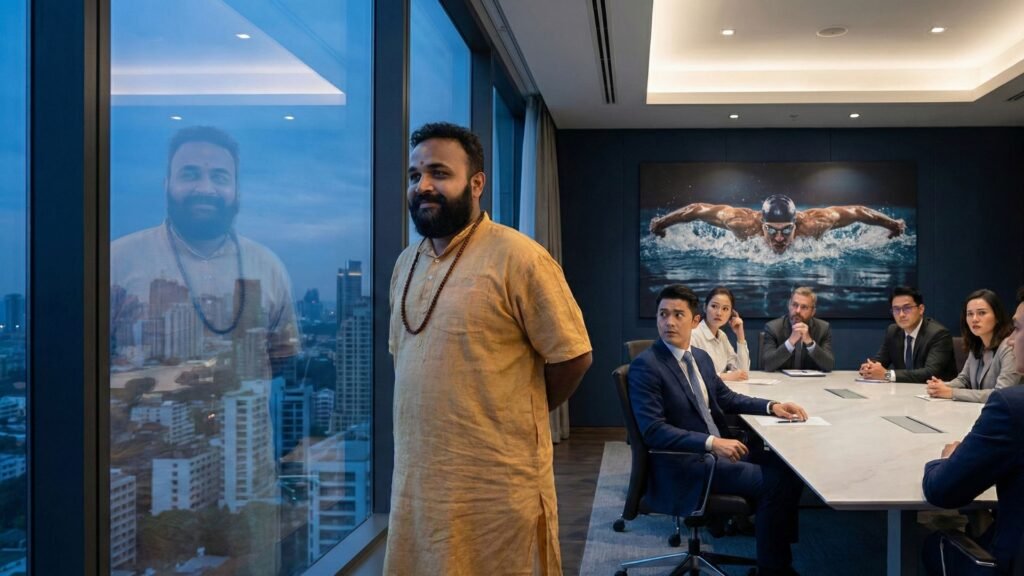
“You claim this world is Maya. But if I jump off this building, gravity kills me. That feels very real. If the physical world is a simulation, what is the substrate? What is the ‘screen’ on which this movie is projected? And why construct the simulation at all if the reality outside of it is full of bliss?”
I listen to the question carefully, my eyes scanning the room. The Physicist is leaning forward, arms crossed, waiting for me to slip on hard science. The Neuroscientist wants a definition of perception. You are asking about the substrate — the screen behind reality.
I take a slow breath. I do not rush. I let the weight of the question settle before I begin to dismantle the illusion, layer by layer.
“Gentlemen, you ask for the definition of Maya. You ask about the screen. You ask why a logical Architect would build a simulation when the reality outside is Bliss. To answer this, I must request that you momentarily set aside your equations and instead observe the psychology of attachment and the relativity of experience.”
My Answer
First, a small clarification. I never claim anything. I only share what I have experienced and understood through life and inner practice.
And from that lived understanding, yes — human life as we experience it is deeply pervaded by Maya.
Before addressing gravity, simulations, and cosmic screens, we must first understand Maya in the most intimate, human way.
When I was born, my parents tell me that as a baby I always held a small piece of cloth. It was nothing special — just an ordinary napkin. But if someone took it away, I would cry uncontrollably. I would hold it, rub it, smell it — as if my security depended on it.
A little later, my father brought me a toy. Gradually, that toy replaced the cloth. Now the toy was “mine.”
Then came a small bicycle. The toy was forgotten. The bicycle became my identity, my pride. I cleaned it like it was part of my own body.
Later came a computer, then a motorbike, then other possessions, ambitions, roles.
Something was always being held. The object changed — the attachment did not.
Even this is still not the full Maya.
The deeper Maya is this: while holding one thing, the mind keeps craving the next. The desire for what is not yet mine blinds me to what is already present. This endless psychological hunger — that is the doorway into Maya.
Maya is not merely objects.
Maya is misplaced identification.
It is when desires override discernment.
When greed dresses itself as ambition.
When fear of losing what we don’t even truly own drives our choices.
Under Maya’s influence, consciousness descends — from Sattva (clarity) to Rajas (restless action) to Tamas (inertia and ignorance). Actions become selfish, harsh, and unconscious.
And this is still only the surface.
The Story of Sudama
There is a beautiful story.
Sudama once asked Sri Krishna, “Show me what Maya is.”
Krishna smiled and said, “First, let us bathe in the Gomati River.”
Sudama dived into the water… and vanished.
He emerged in a distant land. The villagers believed that whoever arrived by the river would be their next king. Sudama was crowned. He lived in luxury, married a queen, had children. Years passed. Life felt real — deeply, emotionally real.
Then one day his queen died. According to custom, the king must enter the funeral fire with her. Sudama was terrified. Villagers dragged him toward the flames.
In that moment of horror, his eyes shut tight.
When he opened them — he was back in the river, with Krishna, just seconds after diving.
“Prabhu… what was that?”
“That,” Krishna said gently, “was Maya.”
Time stretched. Identity formed. Attachment grew. Fear arose. Yet in reality, no time had passed at all. Maya is not non-existence.
Maya is misperceived existence.
Now to Your Scientific Objection
“If I jump off a building, gravity kills me. That feels real.”
Yes. Within the framework of the experience, it is real.
But notice — the impulse to jump often arises from psychological turbulence: despair, hopelessness, identity collapse. That distortion of perception is Maya at work. The physical law is real within the level of the game, but the identification with the suffering mind is the deeper illusion.
You are still thinking we must “escape the simulation.”
No.
The teaching is not to reject the world, but to see through it while participating in it.
We are actors in a cosmic play, but we have mistaken the costume for the Self.
In advanced spiritual practice, this is called Sakshi Bhava — the Witness State. One performs duties fully, passionately, responsibly — but inwardly remains aware: I am not merely this role.
Maya is not the world.
Maya is the forgetfulness of our true nature while engaging with the world.
Why Construct the Simulation if Reality is Bliss?
Let me answer with something simple.
My daughter, who is in class 7, once came home after an exam and said, “Daddy, the paper was very hard.”
I asked her, “What does ‘hard’ mean?”
She tried to explain but couldn’t.
So I told her: “What you know feels easy. What you don’t know feels hard. To make hard things easy, you must learn, practice, and repeat.”
Now consider this:
What happens if someone who has never swum is thrown into the ocean? They drown.
But a trained swimmer, even in rough waters, survives — maybe even thrives.
Nobody lives in the ocean daily. Yet we practice swimming for a possibility.
Similarly, this world is a training ground for consciousness.
Bliss is not emotional excitement. It is a state of vast, stable awareness. An untrained mind cannot sustain it. Just as an untrained body cannot survive deep waters.
This so-called “simulation” is where we develop:
- Emotional stability
- Mental clarity
- Detachment without indifference
- Compassion without collapse
- Strength without ego
Maya is the curriculum, not the prison.
The world is not a mistake. It is a school for the soul.
The Committee’s Reaction
The room is quiet.
The Physicist is staring at the ceiling, mentally replaying the Sudama story as a metaphor for relativistic time dilation and subjective reality frames.
The CTO is nodding slowly at the training-ground analogy.
I look at you.
“Sir, you have answered what we thought was unanswerable. You did not deny physical reality — you contextualized it.
You have shown us that:
- Maya is the shifting of attachment (the napkin to the bicycle)
- Time is relative to the observer (Sudama’s lifetime in a moment)
- The simulation is not a trap but a developmental environment (the swimmer)
You have transformed ‘Illusion’ from a philosophical dismissal into a developmental necessity.
We are not prisoners here.
We are the trainees.”
He pauses, then smiles.
“This concludes the session. You did not merely answer our questions — you expanded the framework in which the questions exist.”
Question 7. Sound and Vibration (Mantra Science):

“My physicists tell me everything is vibration. You use Mantras. Explain to me, scientifically, how a specific arrangement of Sanskrit syllables can alter the physical reality of a person’s life? How does a sound wave manipulate matter or destiny? We want the causal link.”
I listen to the question about vibration and destiny. The Physicist wants a mechanism, not poetry. He wants to know how a pressure wave in air can possibly alter the course of a human life.
I nod, because I once stood on his side of the table.
A few years ago, before I entered deeper mantra sādhanā, I was skeptical too. Repeating syllables felt mechanical, almost superstitious — like chanting without understanding. That changed when I studied my Gurudev’s work on mantra science. He never asked for blind belief. He explained why sound affects consciousness. He replaced mysticism with mechanism.
So let us begin with something you already accept.
You know that sound can break glass. An opera singer can shatter a crystal goblet without touching it. This is not mythology; it is resonance. Every physical structure has a natural frequency. When an external vibration matches that frequency precisely, energy transfer amplifies the internal vibration until the structure changes.
Now extend this principle.
The human body is not just flesh and bone; it is an electrochemical, vibrational system. The skull is a resonating chamber. The vagus nerve responds to vocal vibration. The brain itself operates through oscillatory electrical rhythms. So when specific sounds are produced in a disciplined, rhythmic manner, they do not just travel outward — they travel inward through bone conduction, neural pathways, and breath regulation.
This is where modern research begins to meet ancient practice.
Studies on Bhramari Pranayama — the humming bee breath — show measurable shifts in brainwave activity before and after the practice. During humming, bursts of high-frequency gamma activity appear, especially in temporal regions associated with processing and awareness. Immediately afterward, there is a rise in alpha and theta waves — the same patterns seen in meditative absorption, deep relaxation, and enhanced cognitive integration. Heart rate drops. Blood pressure reduces. The nervous system shifts from sympathetic (“fight or flight”) dominance to parasympathetic (“rest and digest”) regulation.
In simple terms, a controlled sound vibration acts like a gear shift for the brain.
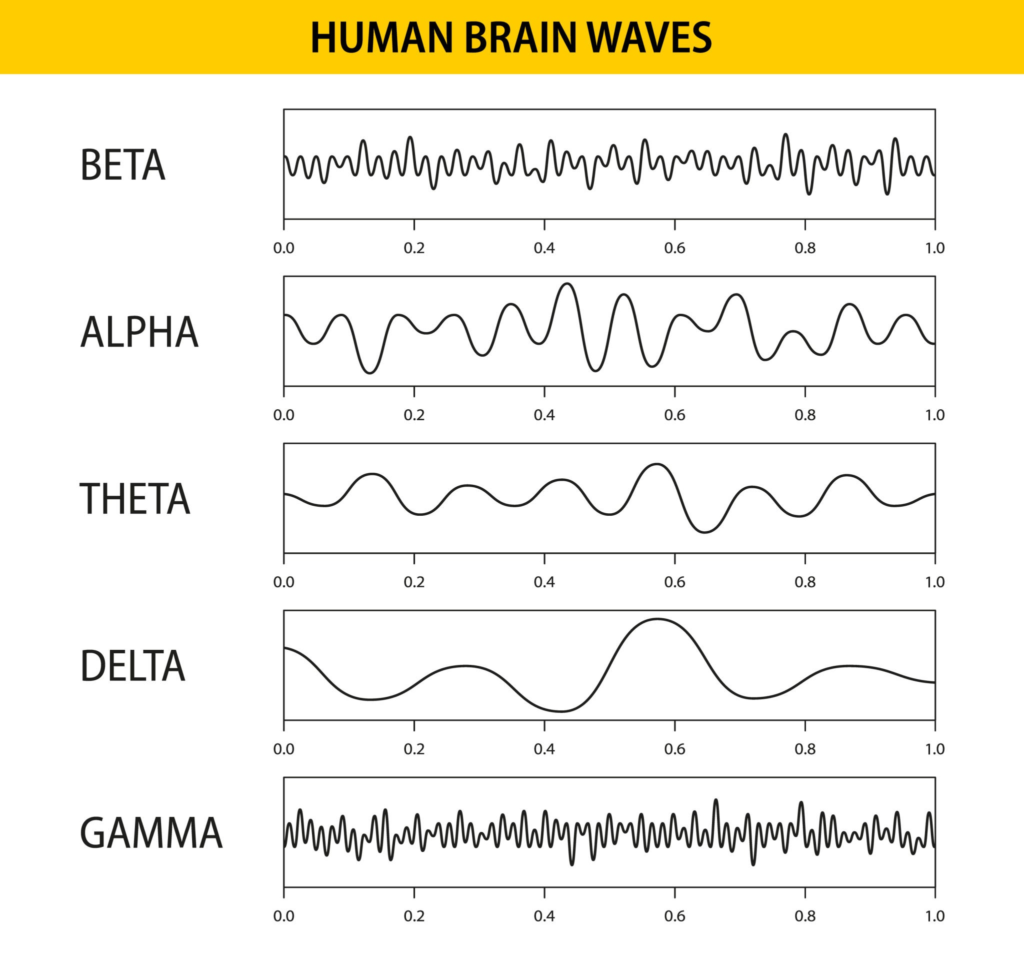
The image of brain waves you see — beta, alpha, theta, delta, gamma — represents different operating modes of the mind. Most stressed humans live in high beta: fragmented attention, anxiety, constant mental noise. Practices like humming, mantra japa, and regulated breath help the brain move toward alpha and theta: calm focus, emotional regulation, creative integration. This is not belief; it is measurable neurophysiology.
Up to this point, we are still within conventional science.
Now we take the next step.
Mantras are not random words with dictionary meanings. They are structured vibrational formulas refined over centuries for their acoustic, rhythmic, and psycho-physiological impact. Sanskrit, in particular, is phonetically precise. Each syllable engages specific parts of the tongue, palate, throat, and breath in a repeatable pattern. That repetition creates stable internal resonance patterns — not only in the vocal tract, but in the nervous system.
But here is where many people misunderstand the claim.
Mantras do not magically rearrange the external world like a fantasy spell. The primary field they alter is the practitioner’s inner state.
Let me explain with something simple.
If I ask you to describe the fragrance of a jasmine flower, you will struggle. You can say “sweet” or “strong,” but words fail. At some point, you must bring the flower to your nose and inhale. Experience completes what language cannot.
Mantra works the same way. Brain scans and research can show correlations, but the transformation is experiential. With sustained, focused practice, the mind becomes clearer, more stable, less reactive. Emotional turbulence reduces. Attention strengthens. Decision-making improves.
And this is where the so-called link to “destiny” appears.
Destiny is not a fixed script falling from the sky. For most people, destiny unfolds as the cumulative result of their choices. And choices arise from mental and emotional states.
A disturbed mind makes impulsive decisions.
A fearful mind avoids opportunities.
An angry mind damages relationships.
When mantra practice shifts the nervous system toward calm regulation and mental clarity, behavior changes. Reactions become responses. Impulses become considered actions. Over time, these micro-decisions alter life trajectories — careers, relationships, health patterns.
From the outside, it may look like “the mantra changed their fate.”
From the inside, the mantra changed the decision-maker.
That is the causal link.
Sound → Nervous system regulation → Brainwave modulation → Emotional stability → Clearer decisions → Different life outcomes.
Nothing supernatural is required to explain the mechanism, though the subjective experience may feel profound.
There are deeper dimensions to mantra science — the geometry of sound, the role of attention, the subtle-body framework described in yogic traditions — but those are best understood through practice, not debate. At some point, theory must give way to disciplined experimentation within oneself.
I finish and look at the panel.
The Physicist is quiet, no longer dismissive. The Neuroscientist is nodding slowly.
You speak at last.
“You did not ask us to abandon science. You extended it inward. You showed that the mantra is not a tool to command the universe, but a tool to tune the instrument through which we experience it. And a tuned instrument plays a different life.”
You lean back.
“Good. Now we move to the final question. Not about the universe… but about the one who is experiencing it.”
Question 8. The Experience of the Void:
![Extreme close-up, face-to-face. The camera is positioned between [THE PROTAGONIST] and the Chairman. The Chairman looks vulnerable, taking off his glasses, tears misting in his eyes. [THE PROTAGONIST] looks at him with infinite compassion and power. The background fades into total darkness/void, making the two faces the only reality. The "Mirror" concept is implied by the intense eye contact. The climax of the session.](https://sriharivediclife.org/wp-content/uploads/2026/02/09-q08-1024x576.jpg)
“I have achieved everything a human can achieve. Wealth, power, recognition. Yet, when I sit in silence, there is a noise in my head I cannot turn off. The ‘Mind.’ My question is simple yet impossible: How does the Eye see itself? How can I use my mind to transcend my mind? If I am the one watching my thoughts, then who is the ‘I’ that is watching the watcher? I need you to show me how to break the loop of the ego using the ego itself.”
I look at you carefully. Not at the Chairman, not at the billionaire, not at the man of influence — but at the human being who is tired of carrying his own mind.
You say there is noise inside that you cannot turn off.
Let me begin by correcting one small but important misunderstanding.
You are not supposed to turn off the mind.
The mind is not the enemy. It is an instrument. Trying to shut it down is like trying to switch off the heart because it beats too loudly. The problem is not that the mind is active. The problem is that it is untrained, running uncontrolled loops of memory, imagination, fear, and planning.
Meditation is not about stopping the mind.
Meditation is about learning how to relate to it differently.
When I first began, I faced exactly what you are facing now. I would sit to meditate, and within seconds I would be lost in thoughts — conversations, worries, plans, old memories, imaginary futures. A single thought would trigger a chain, and before I knew it, ten minutes were gone.
What changed everything for me was one simple shift.
I stopped fighting the thoughts.
Instead, I practiced returning.
A thought appears — I notice it.
Gently, without irritation, I return to the breath.
Another thought appears — again I return.
At first, I could stay with the breath for maybe two seconds before the mind ran away again. But those two seconds mattered. Over time, they became five seconds. Then ten. Then a minute.
This is not philosophy. This is training attention the way an athlete trains muscle. Modern neuroscience calls it neuroplasticity — the brain rewires according to repeated mental habits. Each time you return to the breath, you strengthen the neural circuits of awareness and weaken the circuits of compulsive thinking.
My Gurudev often emphasized that meditation is measured not by how long you sit, but by how many moments you were truly aware. One hour of sitting with a wandering mind is less valuable than one minute of clear, steady awareness. Over months and years, those minutes accumulate and fundamentally change how the mind operates.
Now let us come to your deeper question.
You asked, “How does the eye see itself?”
An eye cannot see itself directly. It needs a mirror.
In the same way, consciousness cannot recognize itself when the mind is turbulent. A disturbed mind is like a lake full of waves. Look into it, and your reflection is distorted. You think the distortion is you.
Meditation is the gradual stilling of the lake.
When the surface becomes calm — even for a moment — awareness recognizes itself, not as a thought, not as a role, not as a memory, but as simple presence. That recognition does not come through analysis. It comes through stillness.
You also asked, “If I am watching my thoughts, who is the one watching the watcher?”
This confusion arises because we are used to identifying with everything we observe.
You say, “I am anxious.” But anxiety is being observed.
You say, “I am thinking.” But thoughts are being observed.
That which observes cannot be the object observed.
Start here, practically — not philosophically.
When a thought arises, instead of entering it, silently note:
“Thinking is happening.”
When an emotion arises, note:
“Anger is being felt.”
“Fear is being felt.”
This small shift in language begins to create inner distance. You are no longer inside every mental event. You are the space in which events appear and disappear.
At first, this witnessing feels like “me watching my mind.” Later, even that sense of a watcher softens. There is just awareness and experience arising within it. No need to chase the watcher of the watcher. That question dissolves when observation becomes effortless and non-personal.
Now about the ego.
You asked how to break the loop of ego using the ego.
Ego is not an object you can attack. It is a process of identification — constantly saying, “This is me, this is mine.” You don’t destroy it by force. You weaken it by not automatically believing every story the mind tells about who you are.
Each time you observe a thought without reacting, you step out of identification. Each time you choose awareness over impulse, the grip of ego loosens a little. Over time, the center of gravity shifts from “I am my thoughts” to “thoughts are appearing in me.”
This is not withdrawal from life. In fact, it makes you more capable of living fully. Decisions become clearer. Reactions become responses. Silence is no longer threatening — it becomes restful.
The “void” you fear is not emptiness in the negative sense. It is empty of noise, but full of presence, clarity, and quiet contentment. The mind does not disappear; it falls into its proper role — a tool, not the master.
You do not transcend the mind by violence.
You transcend it by understanding it, training it, and eventually outgrowing your identification with it.
I pause and look at you again.
“You have conquered markets, industries, and negotiations. This is simply the next mastery — the mastery of attention. The same discipline that built your empire, if turned inward with patience, will reveal a silence that does not depend on success or failure.”
The room is no longer tense.
Because this is no longer a discussion about philosophy.
It is about practice.
I do not speak further for a few moments.
Because this is not a problem that can be solved by more words. It is a problem that softens in the presence of understanding.
You asked how to turn off the noise. Now you see — the noise does not go because you fight it. It fades because you stop feeding it with constant identification.
You have spent a lifetime mastering the external world by controlling variables, predicting outcomes, and influencing systems. But the inner world does not respond to control. It responds to observation without interference.
At first, you will sit and feel like nothing is happening. Then you will realize everything is happening — just without your interference. Thoughts will come. Let them come. Emotions will arise. Let them arise. Your only task is to remain as the one who knows they are arising.
That knowing — that silent witnessing — is the doorway.
Do not try to experience the Void.
Do not try to silence the mind.
Do not try to “achieve” awakening the way you achieved success.
Instead, sit daily. Watch. Return. Watch again.
One day — not because you forced it, not because you deserved it, not because you understood it intellectually — the gap between two thoughts will become noticeable. A small space. Bare, quiet, untouched.
That space is not created.
It was always there.
You do not enter it.
You recognize you have always been it.
And in that recognition, the question “Who is watching?” loses its urgency. Because the watcher is no longer a person trying to observe — it is awareness resting in itself.
This is why the sages say liberation is not an achievement. It is a removal of confusion.
You are not trying to become something else.
You are ceasing to mistake yourself for what you are not.
I look at you — not as a teacher, not as a speaker, but as one traveler to another.
“Sir, nothing is wrong with you. The restlessness you feel is not failure. It is the sign that the outer journey has completed its purpose. Now the inward journey begins — not toward something new, but toward what has always been silently present.”
The room is completely still.
Not the stillness of people waiting to speak.
The stillness of people who have nothing left to argue.
I bow my head slightly.
“The method is simple. The practice is long. The result is certain.”
And with that, the conversation ends — not with applause, not with debate, but with a silence that finally feels like relief rather than noise.